
Before you hire a mold removal company, ask five things: who licenses and insures the company, who writes the remediation plan, how the crew will keep spores out of the rest of the house, how everyone will know the job is finished, and what the contract says about money. A company that answers those clearly, in writing, is usually one you can trust in your walls.
Mold jobs are hard to judge from the outside. You can’t see behind the drywall, and most homeowners hire a mold crew once in their lives. Our guide to choosing a mold remediation company covers the whole decision. This article is the short list of questions to ask on the phone or at the kitchen table, plus the answers you should expect.
Start with size. The EPA says a moldy patch under about 10 square feet (roughly 3 feet by 3 feet) is usually a job you can handle yourself. Past that, or when the water was sewage or other contaminated water, bring in a pro and use the questions below.
1. Are you licensed and insured, and can I check it myself?
Licensing rules for mold work differ from state to state, so ask which license the company holds and then look it up. Don’t take a business card as proof.
In California, the Contractors State License Board (CSLB) requires a license for any job of $1,000 or more in labor and materials. That threshold went up from $500 on January 1, 2025, under Assembly Bill 2622. Most mold remediation jobs clear it easily, because removing drywall, flooring or insulation and rebuilding afterward adds up fast. The CSLB’s advice is simple: hire only licensed contractors, ask to see the license, and verify it online at cslb.ca.gov.
Some states go further. New York, for example, licenses mold assessors and mold remediation contractors separately, and requires licensed professionals for jobs over 10 square feet. If you live outside California, search your state’s licensing board before you sign anything.
Ask about insurance too. You want general liability coverage and workers’ compensation for the crew. A company that hesitates to email a certificate of insurance is telling you something.
What a good answer sounds like
“Here’s our license number and our certificate of insurance. Our technicians are IICRC certified, and we follow the IICRC mold remediation standard.” The EPA points homeowners to the same kind of thing: ask the contractor to follow EPA guidance or the guidelines of groups such as the IICRC or the American Conference of Governmental Industrial Hygienists.
2. Who inspects, and will I get a written remediation plan?
A real mold job starts with an inspection and a plan on paper. The plan should name the moisture source, the areas and materials that will be removed or cleaned, how the work area will be contained, and what has to be true for the job to count as finished.
New York’s mold law spells this out well, and it’s a good model even where it isn’t required. The assessor writes a Mold Remediation Plan that covers the water source, the cleanup methods and the clearance criteria, and the client gets it before work begins. The contractor then gives the client a work plan before the first wall comes down.
Ask how the company found the moisture. Moisture meters and thermal cameras should be part of any inspection. If the leak isn’t fixed, the mold comes back. New York’s Department of Labor puts it plainly: correct the water or moisture source first, or the mold will likely grow back.
Infographic
6 questions to ask before you hire a mold company
- 1Licensed and insured?In California, jobs of $1,000 or more need a CSLB license. Look it up yourself.
- 2Where is the water coming from?No fix for the moisture source means the mold comes back.
- 3Can I see the plan in writing?Scope, containment and clearance criteria, before work starts.
- 4How will you contain it?Plastic barriers, HEPA filtration and negative air keep spores in the work area.
- 5How do we know it’s done?Agree on the finish line up front: no visible mold, dry materials, plan followed.
- 6What’s the deposit?CSLB: no more than 10% down or $1,000, whichever is less.
3. How will you keep mold from spreading to the rest of my house?
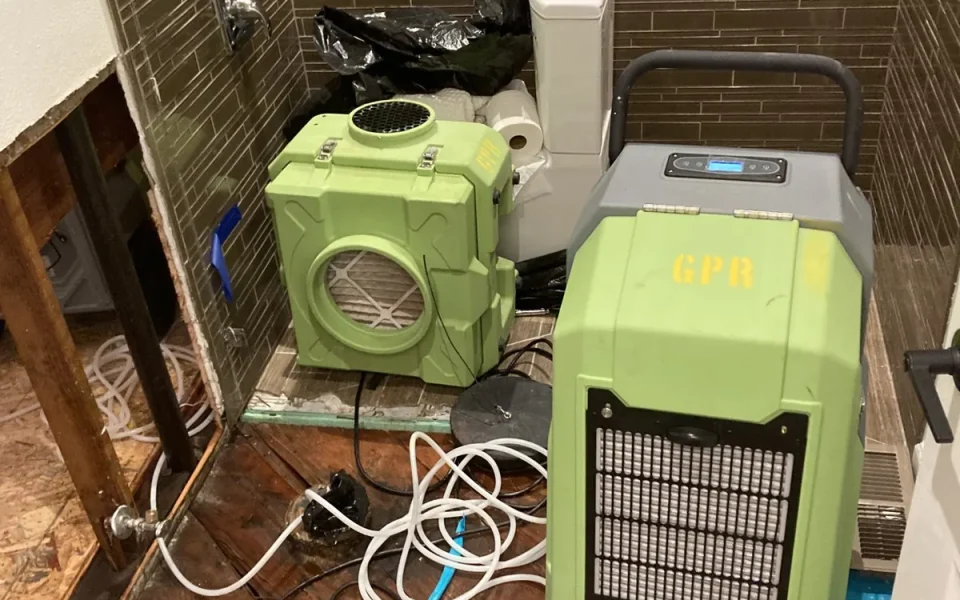
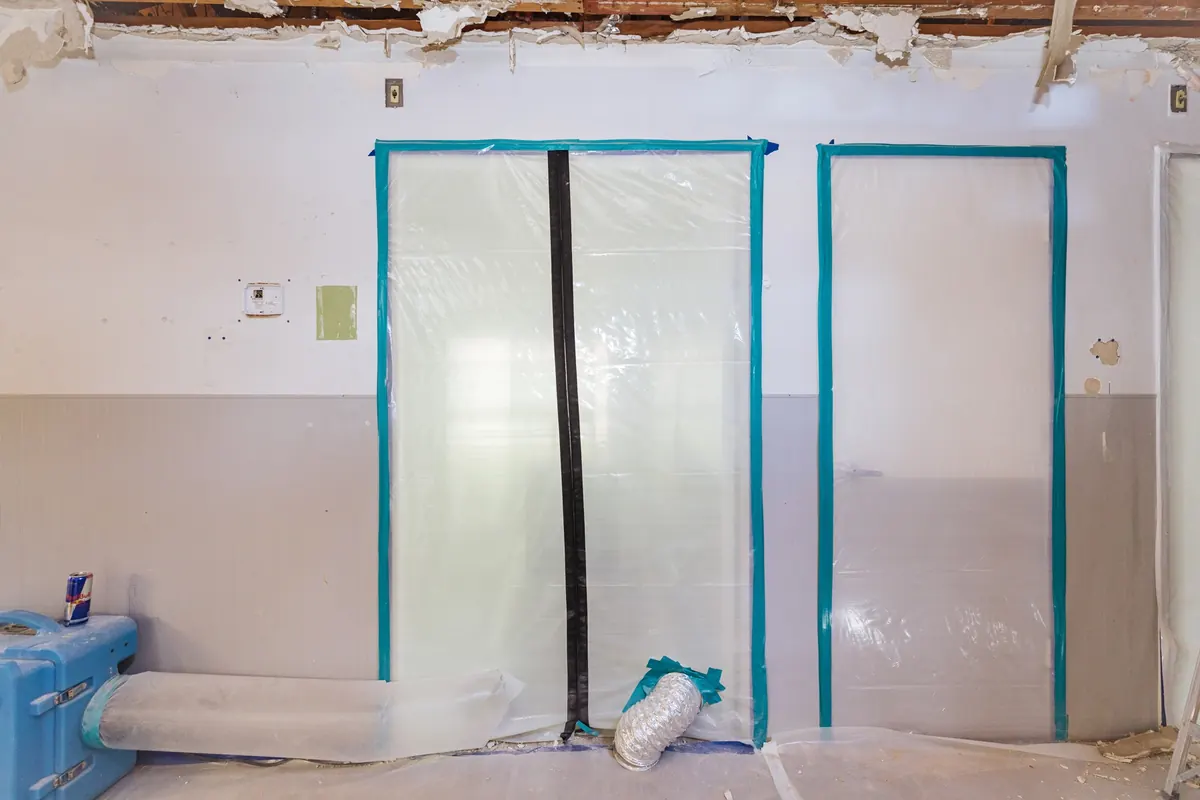
Tearing out moldy drywall releases spores. The question is where they go. A careful crew seals the work area with plastic sheeting and zip doors, runs HEPA air scrubbers, and sets up negative air pressure so air flows into the containment, not out of it. We explain how that works in our post on how negative air pressure keeps mold from spreading.
Ask what the crew wears and how moldy material leaves the house. Bagged debris, covered pathways and HEPA vacuuming at the end are signs of a crew that’s done this many times. Ask how they’ll protect the HVAC system too, since a running furnace or AC can carry spores into every room.
GPR’s team, led by Efraim Haim, CEO of Green Planet Restoration, sets up containment before any material is cut or removed, even on jobs that look small. A patch that looks like 4 square feet on the surface often turns out larger once the wall is open.
You can read the full sequence, from containment to rebuild, in the mold remediation process.
4. Do I need a mold test, and how will we know the job is done?
Here’s a question that sorts honest companies from the rest. The CDC does not recommend routine mold testing in homes. Its reasoning: if you can see or smell mold, it needs to come out no matter what type it is, and there are no set standards for an acceptable amount of mold in a home.
That doesn’t make testing useless. Sampling can help when you smell mold but can’t find it, when a buyer or landlord wants documentation, or when you want an independent check after the work. New York’s guidance says sampling is rarely needed during an assessment. The point is that testing should answer a real question, not pad the invoice. Our post on professional mold testing versus inspections and DIY kits covers when it’s worth paying for.
Then ask about the finish line. In New York, a job is complete when the assessor issues a written clearance report confirming no visible mold, the plan was followed, and the clearance criteria were met. Containment stays up until that report passes. Even where the law doesn’t require it, ask for the same thing: written criteria up front and a written result at the end.
5. What’s in the contract, and how do payments work?
Get it in writing. The scope, the price, the start date and the clearance criteria all belong in the contract. Ask whether rebuild work (new drywall, paint, flooring) is included or quoted separately, because some companies only remove and leave you to find a second contractor.
Watch the deposit. California’s CSLB says not to pay more than 10 percent down or $1,000, whichever is less. It also says not to pay cash, not to let payments get ahead of the work, and to get three bids and check references. The EPA gives the same reference advice.
If insurance may cover the loss, ask how the company handles the claim. A good crew documents moisture readings, photos and removed materials so the adjuster has what they need. GPR’s team, led by CEO Efraim Haim, keeps that record from the first visit. Our insurance billing team can work with your carrier directly, though coverage itself is always up to your policy.
For a sense of what drives the price, see mold remediation cost and pricing.
Hiring for mold removal in San Bernardino
Mold in the Inland Empire usually starts with a slow leak, not a flood. Long valley summers keep AC condensate lines, water heaters and swamp coolers running hard, and a drip inside a wall can go unnoticed until the drywall stains. Up in Big Bear, Lake Arrowhead, Running Springs and Crestline, the usual story is a pipe that froze in an empty cabin and ran for days.
Both cases call for the same questions above, plus one more: how fast can the crew get there before wet materials start to grow mold? If you need mold removal in San Bernardino, our crew works out of 473 E Carnegie Dr and covers Redlands, Fontana, Rancho Cucamonga and Riverside. Call (760) 848-7118 for a free inspection.
Common questions
How big does a mold problem have to be before I call a professional?
The EPA uses about 10 square feet, roughly a 3 by 3 foot patch, as the line. Below that, most people can clean it themselves. Above it, or after sewage or contaminated water, hire a pro.
Should the company that tests for mold also do the cleanup?
Some states, such as New York, split the roles between a licensed assessor and a licensed remediation contractor. Where that isn’t required, you can still hire an independent assessor for the plan or the final check if you want a second set of eyes.
Is mold removal the same as mold remediation?
People use the terms interchangeably. Remediation is the more accurate word, because the job covers fixing the moisture, removing and cleaning affected materials, and confirming the area is clean, not just wiping away what you can see.
Related reading
When you’re ready to talk to a crew, learn more about Green Planet Restoration, or see our mold remediation and testing services.
References
- Centers for Disease Control and Prevention. (2024, September 26). Mold. CDC. https://www.cdc.gov/mold-health/about/index.html
- Contractors State License Board. (2024, December 30). Handyperson exemption to increase to $1,000 in 2025. CSLB. https://www.cslb.ca.gov/Resources/PressReleases/2024/AB2622.FINAL.pdf
- Contractors State License Board. (n.d.). Contractors board warns consumers about unlicensed contractors after disasters. CSLB. https://www.cslb.ca.gov/Media_Room/Disaster_Help_Center/Disaster_Information.aspx
- New York State Department of Labor. (2017). What to expect when you hire a mold assessor and mold remediation contractor. NYS DOL. https://dol.ny.gov/what-expect-when-you-hire-mold-assessor-or-mold-remediation-contractor
- U.S. Environmental Protection Agency. (2026, June 4). Mold cleanup in your home. EPA. https://www.epa.gov/mold/mold-cleanup-your-home
Featured image: Green Planet Restoration photo.
We find the damage, dry or clean the structure and repair it. On site in about 45 minutes, 24/7.

Our articles are written and reviewed by the crews who handle water, fire and mold damage every day across Southern California, Seattle, Miami-Dade and Las Vegas. About us