
Commercial water damage restoration uses the same drying science as residential work, but the job around it is bigger: more people make decisions, more building systems are involved, and every day the space stays closed costs the business money. A homeowner worries about a wet kitchen. A property manager worries about the kitchen, the tenants on both sides, the HVAC return above the ceiling and the lease.
The industry standard for this work, the ANSI/IICRC S500, covers homes, commercial buildings, schools and hospitals in one document. What separates the two kinds of jobs is planning, scheduling, safety and paperwork, not the physics of evaporation.
If you manage an office, a store, a restaurant or a multi-tenant building, our guide to commercial and multi-family water damage covers the bigger picture. This article walks through the five differences that change how a commercial job gets scoped, run and billed.
Bigger buildings mean more systems get wet
In a house, water usually stays in one or two rooms and the drywall around them. In a commercial building it moves through things a house doesn’t have: suspended ceilings, shared wall cavities, elevator pits, fire sprinkler lines, rooftop units and long runs of ductwork.
The ceiling is the one people miss. In many offices the space above the ceiling tiles doubles as the return air path for the HVAC system. The EPA’s commercial mold guide warns that heavy mold growth on ceiling tiles can affect the HVAC system when that space is used as a return air plenum, and it says not to run the HVAC system if you know or suspect it is contaminated with mold. Shutting it off in a working building is a business decision, so it needs to be made early and on purpose.
Multi-story buildings add gravity. A supply line that breaks on the third floor can show up as a stain on the first floor ceiling hours later, which is why a commercial inspection checks the floors below the source and the tenant spaces on either side before anyone writes a scope.
Downtime is often the largest cost
For a homeowner, the main cost is the repair itself. For a business, the bigger number is often the revenue lost while the space is closed, plus payroll for staff who can’t work and the cost of moving operations somewhere else.
That changes the plan. Commercial jobs are often phased so part of the building stays open while crews dry another part. Noisy air movers and demolition get pushed to nights and weekends when possible, which matches the EPA’s advice to schedule remediation during off-hours when building occupants are less likely to be affected.
Insurance follows the same logic. Business interruption coverage can help with lost income, but the Insurance Information Institute notes that these policies generally require losses caused by direct physical damage to the business’s property. Clear records of that damage, from the first hour onward, are what connect the closed doors to the claim.
Infographic
Residential vs. commercial water damage jobs
- 1Same drying clockBoth: EPA advises drying wet materials within 24 to 48 hours to prevent mold.
- 2Who signs offHome: the owner. Commercial: owner, property manager, tenants and often an HOA board.
- 3Systems in playCommercial adds ceiling plenums, sprinklers, elevators and shared HVAC.
- 4SchedulingCommercial work is phased and pushed to off-hours to keep the business open.
- 5Containment sizeEPA: limited containment for 10 to 100 sq ft of mold, full containment above 100 sq ft.
Occupants, workers and safety rules
A family can leave for a few days. A building full of employees, customers or residents can’t always do that, so a commercial job has to keep people safe while they keep using parts of the space.
The EPA’s guide calls communication with building occupants a key part of successful remediation. It recommends sharing the status of the work, including any known or suspected health risks, and naming one person occupants can contact with questions. On our commercial jobs that person is usually the property manager, with our project manager feeding them daily updates.
Containment also scales with the building. The EPA uses the size of the affected area to pick the approach: limited containment for 10 to 100 square feet of mold and full containment above 100 square feet, or when exposure to occupants could be significant. If the water came from sewage or another contaminated source, the same EPA guide notes that OSHA requires protective equipment and containment.
Workers are covered too. OSHA’s fact sheet on mold hazards during cleanup calls for approved respirators, non-vented goggles, long gloves and protective clothing, and it says porous materials wet for more than 48 hours are generally best removed and replaced. A business owner who sends staff to mop up a flooded stockroom takes on that responsibility.
Drying goals and documentation
The drying itself follows the same rules in a dental office as in a ranch house: find all the wet material, remove what can’t be saved, then dry the rest to a measured goal. The difference is the amount of data. A large floor plate might need dozens of moisture reading points, each logged daily, with readings from unaffected areas as the baseline.
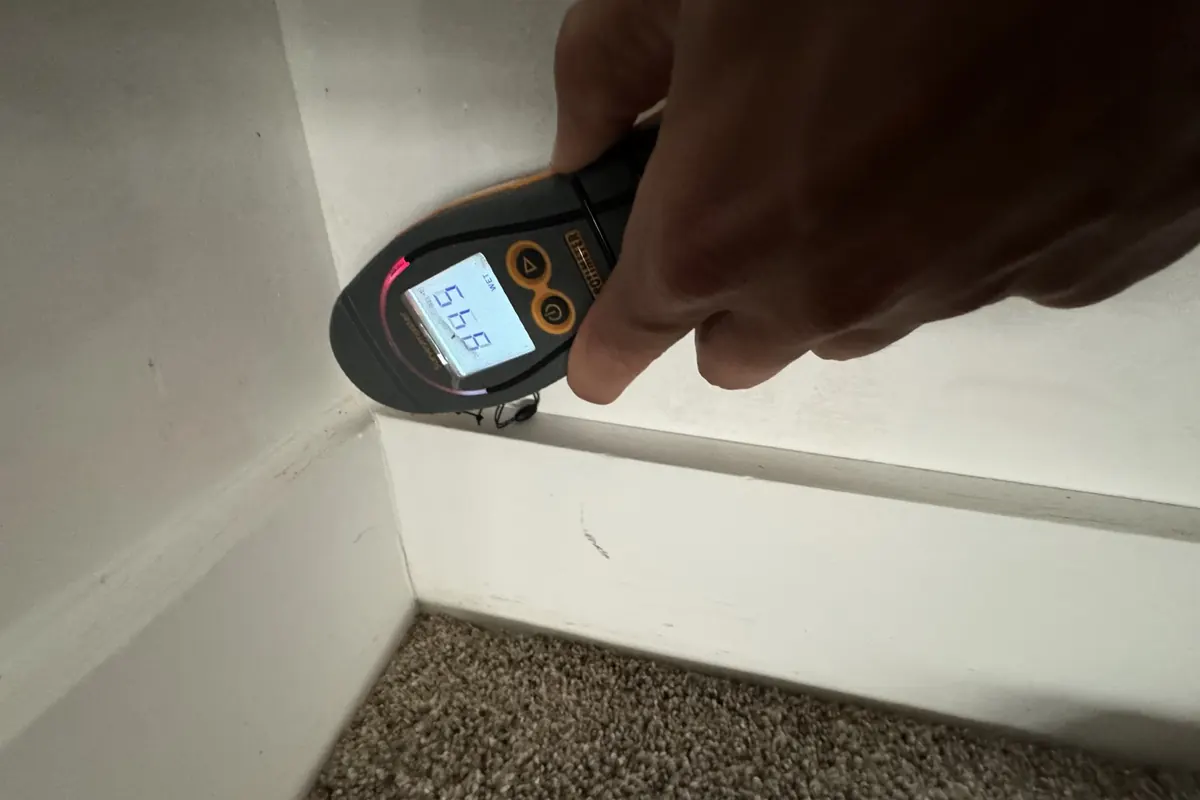
GPR’s team, led by Efraim Haim, CEO of Green Planet Restoration, sets up commercial moisture maps on the first visit and keeps the same reading points through the whole job, so the owner, the tenants and the adjuster all see the same numbers. Those logs also back up any claim for business interruption, because they show exactly which areas were unusable and for how long.
Expect more photos, more equipment logs and a written scope broken out by suite or floor. That level of detail is normal for commercial work, and our insurance billing help is set up to send it to the carrier in the format adjusters ask for.
More people make the decisions
At a house, the homeowner says yes and work starts. At a commercial property, the owner, the property manager, one or more tenants, an HOA board and two or three insurance carriers may each control part of the decision.
Who pays for what usually depends on the lease and the policies. The building owner’s policy often covers the structure, while a tenant’s policy may cover their own improvements, inventory and equipment. The S500 adds one more line: it assumes that finding and fixing the source of the water is the property owner’s responsibility, not the restorer’s. Sorting that out early keeps the drying from stalling while people argue about the bill.
Efraim Haim’s team recommends one point of contact on the client side and one on ours, with a short written update every day. It sounds simple, but it is the main thing that keeps a five-tenant job moving.
Commercial water damage in Irvine and Orange County
Irvine is full of the building types where commercial water damage gets complicated: office towers and flex space in the Irvine Business Complex near the airport, retail and restaurants around the Spectrum, and large HOA-managed communities with shared walls and shared roofs. Much of the city was built from the 1970s onward, so many buildings are now old enough for original supply lines, roof membranes and HVAC drain pans to start failing.
The rainy season usually runs from about November through March, and the first big storms tend to find every flat-roof leak at once. If your suite or common area takes on water, our water damage restoration in Irvine crew works out of the Irvine office on California Avenue and covers the county from Yorba Linda to San Clemente. Call (949) 482-3566 any time.
Common questions
Does commercial water damage restoration take longer than residential?
The drying itself usually takes a similar number of days for similar materials. The total job often runs longer because of approvals, phased scheduling and larger areas to demolish and rebuild.
Can a business stay open during water damage restoration?
Often, yes. Crews can contain the affected area, run equipment in phases and do loud work after hours. If mold is present or the HVAC system is contaminated, parts of the building may need to close.
Who should call the restoration company, the owner or the tenant?
Whoever finds the water should call right away, because drying should start within 24 to 48 hours. After that, the lease and the insurance policies decide who manages the claim and who pays for which repairs.
Related reading
- Commercial and multi-family water damage guide
- What Questions Should You Ask Before Hiring a Restoration Company?
When a pipe, roof or sprinkler line lets go in your building, our water and flood damage restoration team can inspect, extract and dry the space, and you can read more about how our crews work before you call.
References
- Institute of Inspection, Cleaning and Restoration Certification. (2021). ANSI/IICRC S500 standard for professional water damage restoration (5th ed.). IICRC. https://iicrc.org/s500/
- Insurance Information Institute. (2020, April 14). Triple-I offers insights into business interruption insurance coverage. Triple-I. https://www.iii.org/press-release/triple-i-offers-insights-into-business-interruption-insurance-coverage-041420
- Occupational Safety and Health Administration. (n.d.). Mold: Overview. U.S. Department of Labor. https://www.osha.gov/mold
- Occupational Safety and Health Administration. (2013). Mold hazards during disaster cleanup [Fact sheet]. U.S. Department of Labor. https://www.osha.gov/sites/default/files/publications/OSHA3713.pdf
- U.S. Environmental Protection Agency. (2026, January 14). Mold remediation in schools and commercial buildings guide: Appendix C, communicating with building occupants. EPA. https://www.epa.gov/mold/mold-remediation-schools-and-commercial-buildings-guide-appendix-c
- U.S. Environmental Protection Agency. (2026, April 14). Mold remediation in schools and commercial buildings guide: Chapter 5. EPA. https://www.epa.gov/mold/mold-remediation-schools-and-commercial-buildings-guide-chapter-5
- U.S. Environmental Protection Agency. (2026, April 29). Mold remediation in schools and commercial buildings guide: Chapter 3. EPA. https://www.epa.gov/mold/mold-remediation-schools-and-commercial-buildings-guide-chapter-3
- U.S. Environmental Protection Agency. (2026, September 8). Mold remediation in schools and commercial buildings guide: Chapter 4. EPA. https://www.epa.gov/mold/mold-remediation-schools-and-commercial-buildings-guide-chapter-4
Featured image: Green Planet Restoration photo.
We find the damage, dry or clean the structure and repair it. On site in about 45 minutes, 24/7.

Our articles are written and reviewed by the crews who handle water, fire and mold damage every day across Southern California, Seattle, Miami-Dade and Las Vegas. About us